
Current Research Projects
21st Century Borders: Emergent Challenges Within & Among States

The 21st Century Borders grant is a seven-year SSHRC Partnership Grant. The research program builds off the work of the previous Borders in Globalization SSHRC Partnership Grant (2013-2020) which sought to understand the changing nature of borders through six thematic areas in order to document how state-centred and territorially-fixated research limits our understanding of borders. 21st Century Borders builds off the work done in the first grant with the goal of exploring and advancing the required epistemological shift from a state- centric and territorial logic to nodal and mobile logics that focus on both the internal and external forces that challenge the territorial integrity of states. While the first grant revealed the limitations of state-centred and territorially bound understanding of borders, this grant seeks to understand how we, as academics and policymakers, can move beyond that model.
We do this by focusing on three interrelated themes:
- Pillar 1: Looking inside of states at how Indigenous awareness and resurgences, along with increasingly prevalent politics of nationhood and nationalism, affect, fragment, and re-draft intergovernmental relations.
- Pillar 2: Examining the relationship between bordering processes and states’ territoriality, with particular attention paid to examining trade flows and human mobility – both within a states’ international boundaries and across international and transnational legal and regulatory regimes.
- Comparing how the politics in both the above-mentioned cases affect the geopolitics of borders across global regimes.
Understanding, Recovering From and Mitigating Inequities Associated with Travel Measures During COVID-19
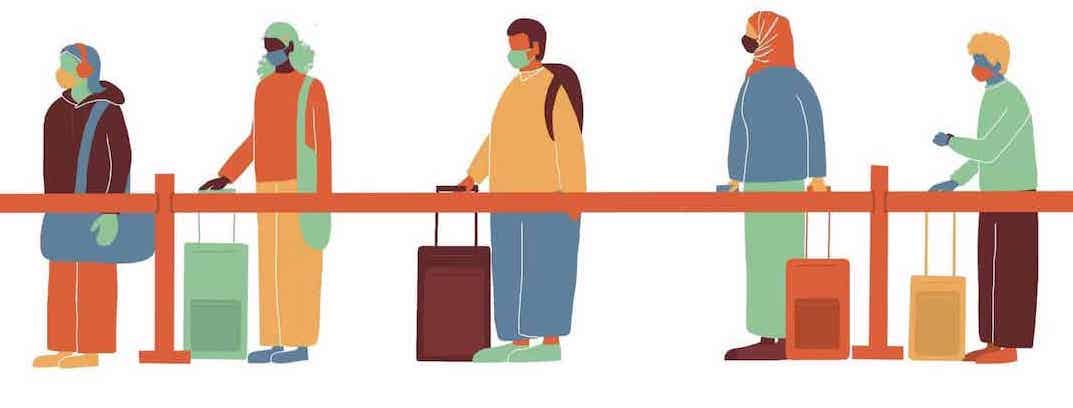
Our new cross-border collaboration with our colleagues at Simon Fraser University, and the launching of our two year project, Understanding, recovering from and mitigating inequities associated with travel measures during COVID-19: Lessons for post-pandemic recovery and future preparedness from Canada-US border management.
The uncoordinated, prolonged and frequently changing use of travel measures during the COVID-19 pandemic has resulted in large-scale disruptions to individuals, economies and whole societies. While tradeoffs have been required between applying measures for public health risk mitigation and the wider societal impacts they cause, limited attention has been given to how these impacts have been experienced differentially across individuals, communities and countries.
Focusing on travel measures for Canada-US border management, this project aims to better understand and develop tools to mitigate travel measure inequities, through a study of the impacts of travel restrictions, quarantine, testing and immunity certificate requirements on selected equity-deserving groups.
This project is a collaboration among researchers based at Simon Fraser University and the Border Policy Research Institute at Western Washington University.
This project is funded by the New Frontiers in Research Fund administered by Social Sciences and Humanities Research Council of Canada (SSHRC). The project will commence in February 2023 and will be completed in January 2025